What If Sustainable Isn’t Good Enough?

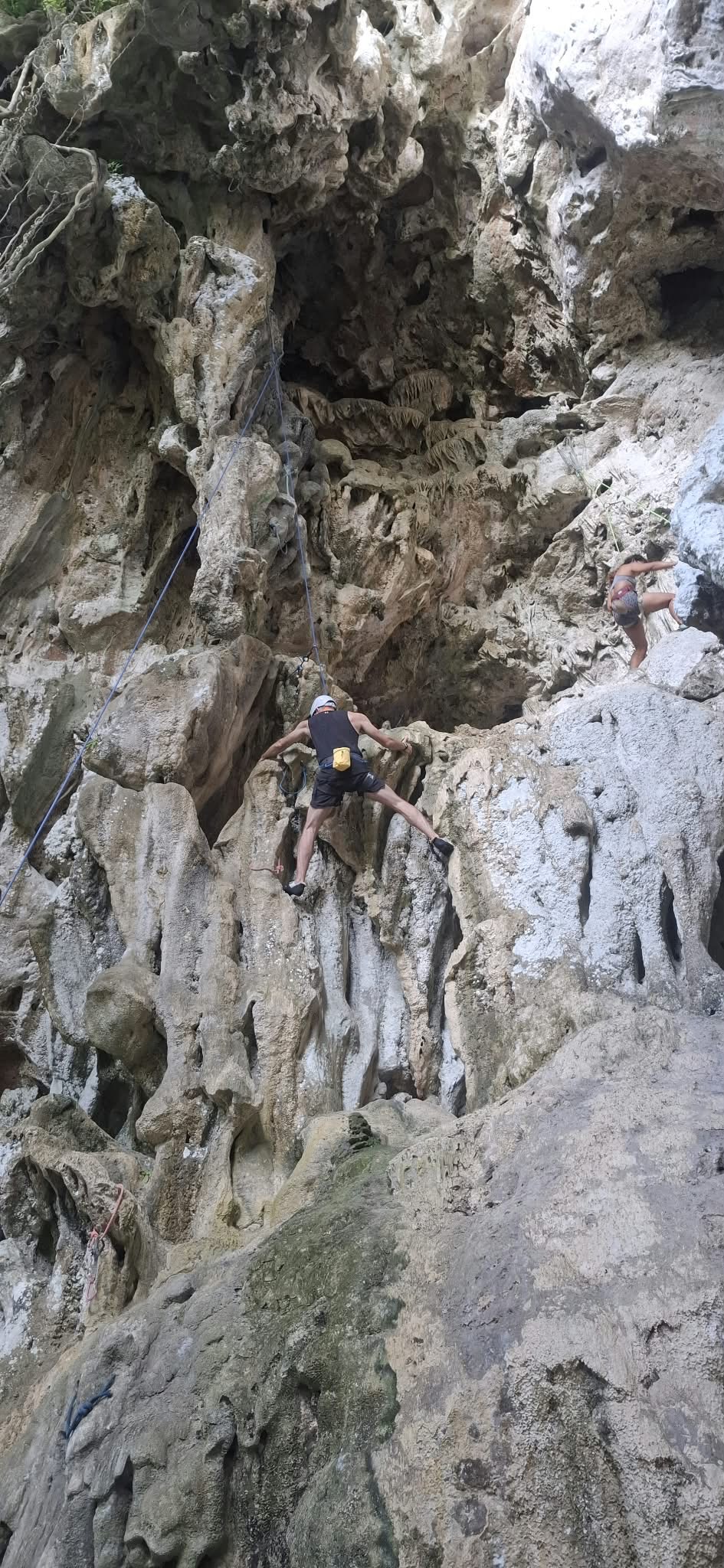
I went to Krabi for a weekend of rock climbing and to meet a new member of the 21C Learning team.
I came back thinking differently about leadership.
That was largely because of Dr. Pierre Echaubard.
Between climbs in the mountain jungle, sitting under a bamboo roof, Pierre started telling me about his work in regenerative social ecology and the work he is doing with students and communities through NatureMind-ED.
Pierre is a French ecologist, educator and researcher who completed his PhD in Ecology at Laurentian University in Canada. Today, his work brings together social-ecological systems, community-based ecosystem restoration, education, human health and resilience. Through NatureMind-ED, he and his team work with students, researchers and local communities on projects ranging from forest regeneration to marine conservation.
What started as a conversation about ecology eventually became a conversation about leadership.
And one idea stuck with me.
For years, we have talked about sustainability. How do we protect what we have? How do we reduce our environmental impact? How do we stop making things worse?
All important questions.
But what if sustaining what we have isn’t enough?
From protecting to regenerating
If a system is already damaged, sustaining it simply sustains the damage.
The goal has to become regeneration.
Protecting a forest matters. Regenerating a degraded forest asks how we help it become healthy again. Protecting a coral reef matters. Restoring damaged coral helps rebuild what has been lost.
Regenerative thinking goes further still.
It asks how we strengthen the conditions that allow the whole system to continue renewing itself.
This wasn’t entirely new territory for me.
At The International School of Macao, our Activist in Residence (https://sites.google.com/tis.edu.mo/ayearfortheocean/home?pli=1&authuser=0) program included work on coral restoration with Andrew Taylor. My master’s degree research explored chaos and complexity theory and open systems. More recently, I returned to those ideas in my article From Factory to Ecosystem: The Evolution of School Leadership, arguing that schools make more sense when we understand them as open, dynamic systems rather than predictable machines.
Factories can be optimized.
Ecosystems have to be understood, nurtured and continually adapted.
That distinction is becoming increasingly important to how I think about leadership.
You can’t fix one part of a system and ignore the rest
Pierre’s own journey to Thailand began with a public-health problem in Isan, in northeastern Thailand.
Far too many people were developing cholangiocarcinoma, a cancer of the bile duct. Researchers had identified an important part of the causal chain. A parasitic liver fluke, Opisthorchis viverrini, is endemic in the region, and chronic infection substantially increases the risk of developing the disease.
One of the primary routes of infection is through eating raw or undercooked freshwater fish, something deeply connected to local food culture.
At first glance, the solution seems remarkably simple.
Stop eating raw fish.
Problem solved.
Except it isn’t.
That solution makes perfect sense if you isolate one variable. Raw fish transmits the parasite, so eliminate the raw fish.
But people don’t live inside flowcharts.
Food is culture. It is family. It is tradition. It is economics. It is what is locally available. It is knowledge and practice passed between generations. And in this case, it is also connected to an ecological cycle involving people, fish, snails, waterways and parasites.
Suddenly, what looks like a simple public-health problem isn’t simple at all.
Pierre’s own research explored precisely this problem. His work on liver-fluke control in Southeast Asia argues for moving beyond narrowly biomedical interventions toward approaches that recognize the broader social, ecological and cultural system in which disease transmission occurs.
You can tell a community to stop doing something it has done for generations. You can put up posters. You can explain the medical evidence.
That doesn’t mean behaviour will change.
And even if you successfully treat an infected person, that person returns to the same social and ecological system in which the infection occurred.
That was the part of Pierre’s story that caught my attention.
Improving human health required understanding ecology. Changing behaviour required understanding culture. Making that change last required understanding how all of those things interacted.
You couldn’t isolate the person from the ecosystem and expect to understand the problem.
And somewhere under that bamboo roof in Krabi, our conversation moved from ecology to leadership.
Because schools do this all the time.
What if the thing we are fixing isn’t actually the problem?
We see a problem and immediately try to fix the visible problem.
Teacher turnover is too high? Improve retention.
Student results are declining? Change the curriculum.
Enrollment is falling? Invest in marketing.
Teachers are exhausted? Introduce a wellbeing program.
But what if the thing we are trying to fix isn’t actually the problem?
What if it is a symptom of the system?
A wellbeing initiative doesn’t regenerate a culture that continually exhausts people. A marketing campaign doesn’t fix a school whose families no longer believe its value proposition. Replacing an underperforming leader doesn’t necessarily change the conditions that made leadership unsuccessful in the first place.
Regenerative leadership asks us to look beneath the visible problem.
Not simply:
How do we fix this?
But:
What is happening in this system that keeps producing this outcome?
And then perhaps the more important question:
What conditions would allow this system to become healthier and increasingly capable of renewing itself?
That question sent me down a rabbit hole.
What would regenerative leadership look like?
Most leadership is built around growth and improvement. Schools are no exception.
Increase enrollment. Improve examination results. Raise university acceptance rates. Improve retention. Grow revenue. Increase engagement. Hit the strategic plan targets.
We measure whether our actions produced the results we wanted.
Regenerative leadership asks a different question:
What is becoming healthier and more capable because we are here?
The field of regenerative leadership is still emerging, and the term doesn’t yet describe one universally accepted leadership theory. Its intellectual roots stretch across regenerative development, systems thinking, ecology, complexity theory and living-systems thinking.
Bill Reed’s influential paper, Shifting from Sustainability to Regeneration, helped articulate the move from doing less environmental harm toward developing the capacity of living systems to evolve and renew themselves.
More recently, Giles Hutchins and Laura Storm have brought these ideas explicitly into organizations through their work on regenerative leadership. They describe a shift away from mechanistic approaches to management toward leadership informed by the dynamics of living systems.
As I have started exploring this work, several ideas have challenged how I think about leading schools.
1. Your school isn’t really an organization. It is a living system.
Schools are usually represented by organizational charts.
Boxes, lines, departments and reporting structures.
But that isn’t how schools actually work.
A school is a constantly changing network of students, teachers, families, leaders, owners, governors, universities, regulators, communities and cultures. Change something in one place and effects emerge somewhere else, often somewhere you didn’t anticipate.
This is exactly what drew me to chaos and complexity theory years ago.
In complex adaptive systems, relationships matter as much as individual components. Feedback loops matter. History matters. Context matters. Small changes can sometimes produce disproportionately large consequences.
Leadership therefore becomes less like operating a machine and more like tending an ecosystem.
You cannot control every outcome.
You can influence the conditions from which outcomes emerge.
That distinction matters.
2. Stop asking only what your organization needs from people.
Schools constantly ask how we can get more from our teachers, improve student performance, increase parent engagement and develop our leaders.
Regenerative thinking turns some of those questions around.
Are people becoming more capable because they work here?
Are teachers leaving your school stronger than when they arrived?
Are leaders developing other leaders?
Are students developing the capacity to contribute to communities rather than simply succeeding within them?
Is the community stronger because your school exists in it?
Growth that continually consumes the capacity of the people producing it isn’t regenerative.
Eventually, you run out of people.
3. Healthy systems create capacity, not dependency.
This may be the idea that interests me most.
Traditional leadership can make the leader increasingly important. The organization succeeds because a talented person keeps solving its problems.
Regenerative leadership should produce the opposite result.
The system becomes increasingly capable of solving problems without you. People develop judgment. Leadership becomes distributed. Relationships strengthen. Knowledge spreads. New leaders emerge.
The leadership question changes from:
What did I accomplish?
To:
What can this organization now accomplish that it couldn’t accomplish before?
Those are very different measures of leadership.
4. Sometimes resilience isn’t enough.
We celebrate resilient organizations and resilient people.
But resilience can simply mean surviving something unhealthy.
A dysfunctional culture can be remarkably resilient. So can a bad system.
Regeneration asks more.
After disruption, do we simply return to where we were, or do we learn, adapt and become healthier because of what happened?
The goal isn’t always to bounce back.
Sometimes you shouldn’t go back.
5. Leadership becomes stewardship of conditions.
This connects most strongly with my earlier work in complexity theory.
In complex systems, leaders cannot reliably engineer outcomes through linear cause and effect. Do X and Y doesn’t necessarily happen. People interact. Circumstances change. Feedback loops develop. Unexpected consequences emerge.
Donella Meadows’ classic work on leverage points in systems makes an important distinction between changing visible parameters within a system and intervening in deeper things such as information flows, rules, goals and ultimately the paradigms from which the system operates.
Perhaps leadership, then, is less about controlling outcomes and more about creating conditions.
Conditions for trust, learning, experimentation, honest disagreement and development.
Conditions in which new ideas can emerge.
Conditions in which the organization becomes increasingly capable of renewing itself.
You still set direction. You still make decisions. You still hold people accountable.
But you pay much more attention to the system those decisions are creating.
Maybe we are measuring the wrong thing
Imagine a school that doubles enrollment in five years. Revenue increases. Facilities expand. Results remain strong.
By almost every conventional measure, the leadership team has succeeded.
But during the same period, teacher workload becomes unsustainable. Middle leaders burn out. Relationships become transactional. Institutional knowledge disappears as turnover rises. Families feel less connected. The surrounding community barely interacts with the school.
Did the organization actually become stronger?
Or did it grow while consuming the system that made the growth possible?
That distinction deserves much more attention.
It also takes regenerative leadership beyond environmental sustainability. Regeneration can apply to human systems, organizational cultures and communities as much as forests or coral reefs.
A regenerative school should leave its people, its community and perhaps even its physical environment with greater capacity than it found them.
Not simply less damaged.
Stronger.
I am still exploring this
There is a danger with every new leadership idea.
We discover a new term, write a framework, put it on a conference slide and suddenly everything we’ve been doing for twenty years gets relabelled.
I don’t want to do that with regenerative leadership.
The research base is still developing. Some of its ideas overlap significantly with systems leadership, complexity theory, organizational learning, sustainability, ecological thinking and Indigenous and place-based understandings of our relationship with living systems.
There are also questions still to be answered about how we measure regeneration in organizations and whether some of what is being described as regenerative leadership is genuinely new or simply established ideas being assembled under a new label.
Maybe that is why I find it interesting.
It connects several ideas I have been thinking about for years, but changes the question underneath them.
We have spent decades asking leaders to build successful organizations.
Perhaps we need to ask something harder:
Does your leadership leave the system healthier than you found it?
Your people.
Your culture.
Your community.
Your organization.
And, increasingly, the living world around it.
Protecting what remains matters.
But sometimes sustainability isn’t enough.
Sometimes the job is to regenerate.
Go deeper
If this idea interests you, these are good places to continue exploring:
Dr. Pierre Echaubard and NatureMind-ED
Pierre’s work connecting ecology, education, community engagement and ecosystem regeneration in southern Thailand.
Echaubard & Sripa: The Role of Evolutionary Biology in Research and Control of Liver Flukes in Southeast Asia
A useful example of Pierre’s argument for understanding health problems through broader evolutionary and ecological systems rather than through biomedical interventions alone.
Sripa & Echaubard: Prospects and Challenges Towards Sustainable Liver Fluke Control
Explores why sustainable control requires integrated approaches that account for the complexity surrounding transmission and human behaviour.
Bill Reed: Shifting from Sustainability to Regeneration
One of the foundational papers behind the shift from sustainability toward regenerative development.
Giles Hutchins & Laura Storm: Why Regenerative Leadership Has to Be the New Norm in Business
An accessible introduction to their living-systems approach to regenerative leadership.
Donella Meadows: Leverage Points, Places to Intervene in a System
Still one of the clearest explanations of why changing a complex system requires looking beyond its most visible problems.
Howard Stribbell: From Factory to Ecosystem: The Evolution of School Leadership
My earlier exploration of why schools are better understood as open, complex ecosystems than as predictable machines.
I would use the title above and the subtitle: “A conversation in the mountains of Krabi led me from ecology to a much bigger question: what if good leadership isn’t just about growing organizations, but leaving them healthier than we found them?”


.png)